Home › Services
Aluminum fence Columbus Ohio: ornamental panels that follow your grade
Ornamental aluminum is the fence you choose when you want to see through it and never want to paint it. It is the front-yard material, the pool-enclosure material, and the only common fence that bends to follow a hill instead of leaving a triangle of daylight under every panel. It is also the material where the difference between a good product and a cheap one hides inside the tubing, so the spec sheet matters more than the finial style. Here is what separates the grades, how the finish fails, and why the panel decides the post layout.
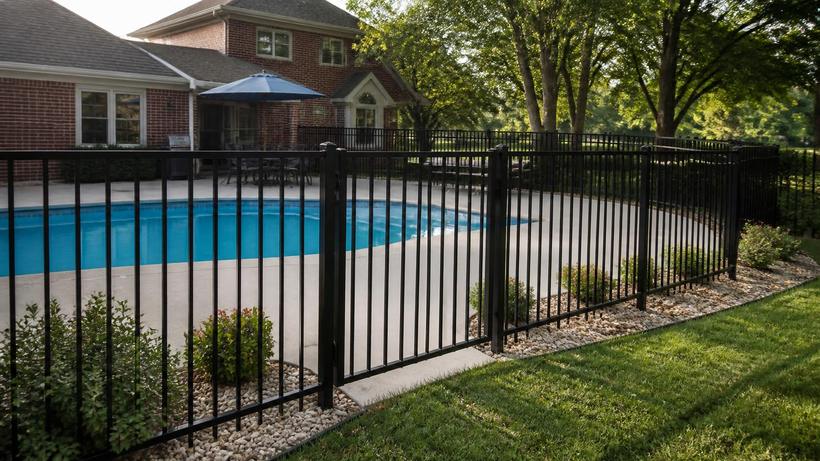
Aluminum, steel and true wrought iron are three different things
Real wrought iron is hand-worked low-carbon metal with slag threaded through it, and it has not been produced in volume for generations. Almost everything sold under that name now is welded steel picket, primed and coated. Steel is stronger, and on a tall security enclosure or a wide commercial gate leaf that strength earns its keep. In a residential yard it mostly buys maintenance: water finds a scratch, a weld or an open cut end, oxidation starts inside the tube, and rust takes up more room than the steel it replaced, so it pushes the coating off from underneath.
Aluminum corrodes too, but in a way that stops itself. The oxide forming on bare aluminum is thin, tight and stable, sealing the surface instead of flaking away to expose fresh metal, so a deep scratch chalks, dulls and quits. It cannot rust through at the ground line, which is how old iron fences die, and that one property is why ornamental aluminum took the residential market.
Residential through commercial grades, and what actually changes
Tier names are marketing; the dimensions behind them are not. Two fences can look identical from the sidewalk and be built to completely different strength, because the picket face barely changes between grades while the structure does. Ask for numbers, not the tier label.
- Post size -- the biggest difference between grades, and what decides whether the line stands straight in ten years.
- Wall thickness of the picket and rail tubing: thousandths of an inch, invisible from three feet, and what makes the fence feel solid.
- Rail count. Two rails is the standard ornamental look; a third stiffens the panel and is normal on taller runs.
- Picket spacing. Wider reads lighter and costs less; tighter is what pool rules and dog owners are after.
- How pickets attach. Pickets running through punched rails, retained internally, beat pickets screwed to the face of a rail.
- Gate hardware. Heavier lines carry hinges rated for real cycle counts, which is why a pool gate often borrows a tier above the fence.
Picket profiles, rail profiles and the top you choose
Nearly all ornamental aluminum is extruded square tube, so character comes from the rail profile and how the pickets end. Flat-faced rails read modern; a rail with a step or bevel catches light and reads traditional. A heavier picket on identical spacing looks noticeably more substantial. Top style is mostly aesthetic, with a few practical consequences.
- Flat top, or flush top. Pickets stop at the top rail: quiet, modern, safest beside a walkway or play area.
- Spear top, sold as pressed point or finial top. Pickets rise above the rail to a point: classic, discourages climbing, worth a second thought beside a sidewalk.
- Puppy picket, also called a dog panel: extra pickets at half spacing across the lower portion so a small dog cannot slip through, open look above.
- Extended bottom picket, running below the bottom rail to deter a digger, though it wants a clean grade underneath.
Rackable panels: the one thing this material does better than anything else
Most ornamental aluminum panels are built rackable: the pickets attach with enough freedom that the panel pushes out of square, so pickets stay vertical, rails tilt with the slope, and the panel hugs the ground its full length. Manufacturers publish how much rise a panel takes. A solid fence cannot do this: a rigid rectangle either steps down a hill, leaving daylight under each panel, or gets custom-cut board by board.
Stepping is still right sometimes. A sharp break at a retaining wall or drive apron is cleaner stepped, because racking through an abrupt drop twists the panel.
- Walk the line and mark anywhere the ground moves more than a boot height inside one panel length.
- Note low spots where water stands, because leaves trapped at a bottom rail stain the finish first.
- Decide how much gap under the fence you can accept, since a dog may want a puppy panel instead.
- Ask each bidder in writing whether the panels rack, how much rise they take, and which sections get stepped instead.
Gates, self-closing hardware and pool barrier requirements
A panel just stands there; a gate moves thousands of times a year, and every cycle works on the hinges, the frame corners and the post. Aluminum gate frames are welded rather than screwed, and wide leaves need internal reinforcement to keep from sagging out of square. Past a certain width, a double gate with a drop rod beats one heavy dragging leaf.
Around a pool, hardware stops being preference and becomes a code matter. A barrier rule is a family of requirements, not a number: overall height, how far apart pickets may sit, whether a horizontal member gives a child a foothold, the gap at the bottom, how high the latch sits and which side it faces, and above all that the gate be self-closing and self-latching, returning to latched on its own from any open position. Spring hinges with a magnetic or gravity latch are the usual answer. Every figure comes from the code your community adopted -- confirm them before panels are ordered, because spacing and latch position are not cheap to retrofit.
Powder coat quality, and how the finish actually fails
The color is powder coat: dry pigment and resin sprayed electrostatically, then baked until it flows into a continuous film. On properly pretreated aluminum it is far tougher than paint. Done cheaply it is the first thing to go, and the variables are pretreatment, film thickness and whether the resin is a polyester built for sunlight. A fence that chalks badly on its south-facing run within a few seasons got the wrong chemistry, not bad weather.
The usual failure point is not mid-picket but any end cut after coating -- a panel shortened on site, a picket trimmed to fit, a rail closed out against the house. Each cut opens bare metal inside the tube that no coating reached. Aluminum will not rust through from it, but the film at that edge has nothing anchoring it and can lift and peel back, and a wet bare edge beside steel fasteners invites galvanic staining. Careful layout keeps cuts few, and each gets touched up in the matching finish.
Mulch piled against the bottom rail keeps the coating damp, and a sprinkler aimed at the fence leaves deposits people attack with something abrasive. Mild soap and water is the whole routine.
Post setting for ornamental panels: the panel dictates the spacing exactly
With wood, posts go where they make sense and boards get cut to fit. Ornamental aluminum is the reverse. The panel is a manufactured unit of fixed length, and posts must land exactly where it says or the panel does not attach -- no trimming a routed panel to close a gap, no stretching one to cover it. The line gets laid out backward from the panel dimension, with the remainder absorbed in a shortened closure section, at a corner, or at the gate.
So accuracy matters more here than with other materials. Posts get set to a string line and measured on center, holes go below the depth where the ground freezes -- typically close to three feet in central Ohio, and the department having jurisdiction sets the number that actually counts -- and the glacial till under central Ohio holds water against a post, so the hole wants a gravel bed. Corners, ends and gate posts carry more load than a line post. The full sequence, from marking the line and 811 locates through hanging gates, lives on the fence installation page.
Front yards, street-facing runs and aluminum in front of a privacy fence
Most of the ornamental aluminum going up around Columbus is not containing anything. It defines a front yard without walling it off, carries a line along a sidewalk, fences a corner lot where solid fencing would look hostile, and wraps a pool or garden without hiding it. Because it is see-through, communities usually treat it more generously in front of the house, where allowable height is lower -- a figure only the city or township can give you.
Black is the default because it visually disappears at a distance and reads as traditional iron, sending the eye to the landscaping. Bronze and dark brown sit well against brick. White suits streets where the prevailing look is white plank or post and rail, an aesthetic worth matching rather than fighting, as anyone fencing a yard in New Albany already knows.
The most useful arrangement is a combination: ornamental across the front and visible side, then a solid fence from a corner post back. The solid half is usually wood privacy fence, or vinyl if you would rather never refinish anything. Where the rear line is only a boundary, chain link closes it for less.
What moves the number on an aluminum quote
Footage, height, gate count and grade move the price far more than color or finial style. Gates are the expensive part per foot by a wide margin, so two instead of three is worth more than most material upgrades. A rackable run over a steady slope adds little; stepping and custom raked panels add real labor.
Spend on what cannot be changed later -- post size, wall thickness, rail count, gate hardware -- and skip the decorative rings and castings if the budget is tight. A quote worth comparing states tube dimensions, picket spacing, rail count, post size and setting method, the rackable rating, every gate with its width and hardware, and which sections are stepped.
Be honest about what the material will not do: it screens nothing, blunts no noise, a climber treats a horizontal rail as a step, and a falling limb folds pickets heavier fencing would shrug off. Damage stays local, though, so record the manufacturer, product line and finish color inside a gate post while the paperwork exists.
If a fence already stands and only part of it is failing, that is a fence repair conversation instead. For a new line, send the address and photos from both ends of the run, including anywhere the ground falls away, through the contact page.
Aluminum fence Columbus Ohio — common questions
Does an aluminum fence rust?
Not the way steel does. Aluminum forms a thin, stable oxide that seals its own surface rather than flaking off to expose fresh metal, so a deep scratch dulls and then stops. A picket cannot corrode through at the ground line, which is how steel and old iron fences fail. What can go wrong is cosmetic: powder coat may chalk if the resin was wrong, and an untouched cut end lets the finish lift from that edge.
Will an aluminum fence keep my dog in the yard?
Often, with the right specification. Standard picket spacing is wide enough for a puppy or small breed to walk straight through, which is why puppy panels exist: extra pickets at half spacing across the lower portion, open look above. For a digger, an extended bottom picket helps. For a jumper, height is the only real fix. A big athletic dog may need a taller fence than the ornamental look flatters.
What is the difference between rackable and stepped aluminum panels?
A rackable panel pushes out of square so the rails tilt with the slope while the pickets stay vertical, letting the fence follow the ground in one line with no gap underneath. A stepped install keeps each panel level and drops it at every post, leaving a triangle of daylight below. Racking suits the steady slopes most central Ohio yards have; stepping suits abrupt breaks like a retaining wall.
Can aluminum fencing be used around a swimming pool?
It is the most common choice for exactly that: see-through, no horizontal footholds when specified correctly, and unbothered by splash-out. What makes it a legal barrier is the detailing rather than the material -- picket spacing, height, the gap at the bottom, latch height and placement, and a gate that is self-closing and self-latching from any open position. Those figures come from the code your community has adopted.
Can you repaint an aluminum fence a different color?
You can, but understand the trade. Factory powder coat is baked on and tougher than anything applied in a yard, so repainting swaps a durable finish for a recurring chore. If a color change is unavoidable, the surface has to be washed clean of chalking, scuffed for adhesion, and primed with a product made for aluminum. For small damage, touch-up finish in the matching color is better.
Is aluminum cheaper than steel or iron fencing?
Usually, and the gap widens over the life of the fence, because a factory finish never needs the scraping and repainting cycle a steel or iron fence eventually demands. Lighter panels are also faster to handle, which shows up in labor. Steel still wins where impact resistance or a very tall enclosure is the point. Within aluminum, grade moves the number more than style does.
Can I get any privacy from an aluminum fence?
Not meaningfully from the fence itself, and pretending otherwise leads to disappointment. What works is planting: an ornamental fence gives arborvitae, a hedge or a row of shrubs something to grow against, and in a few seasons the green screens while the fence holds the line. The other approach is a combination, ornamental across the street-facing portion and a solid fence from the corner of the house back.
Talk through your site
Start with the address, what you want done, and a few photographs of the area, including anywhere water sits after a heavy rain.
Related work
Fence Installation
New residential fences, laid out, set and finished for central Ohio frost and glacial till.
Fence Repair
Leaning posts, dragging gates, wind damage and rotted boards, and when a repair stops making sense.
Wood Privacy Fences
Board-on-board, shadowbox and stockade privacy fences, and what makes wood last here.
Vinyl Fences
Low-maintenance vinyl privacy and picket fences and how they behave in an Ohio winter.
Chain Link Fences
Galvanized and black-coated chain link for yards, dogs and back property lines.
Across the metro
Upper Arlington
Established streets, mature trees and tight side yards where access decides the method.
Worthington
An older village core plus newer subdivisions, with big trees and creek-side grade changes.
New Albany
Planned neighborhoods where architectural review has a say before anything is ordered.
Pickerington
Newer Fairfield County subdivisions, flat lots, dogs and covenants on height and style.