Home › Services
Fence installation Columbus Ohio, from marking the line to hanging the gate
A new fence is mostly decisions made before a single hole gets dug. Where the boundary runs, what the city or the association wants on paper, how deep the holes go, what goes in them, and how a run of pickets crosses a yard that drops two feet corner to corner -- those choices decide whether the fence still reads straight in its fifth winter. This page walks the job in the order a crew works it in central Ohio, so you know what to ask for and what each day looks like. Material behavior lives on the individual fence pages; everything here is process.
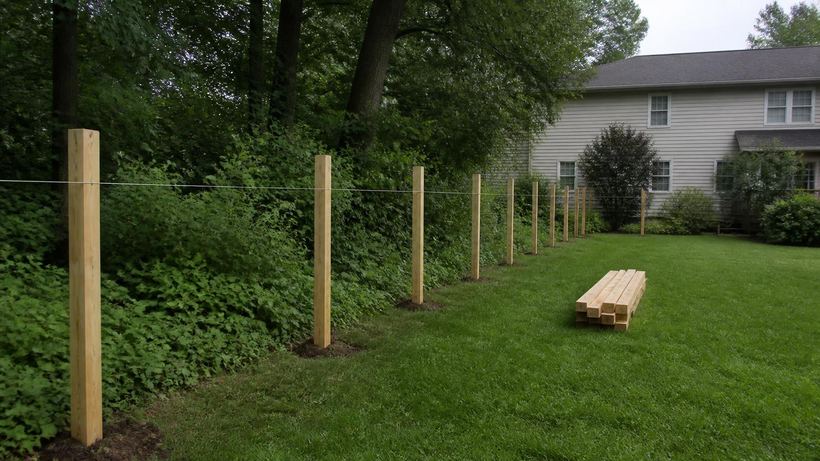
Find the line, then walk the layout together
Almost every fence argument between neighbors traces back to a boundary somebody assumed. The reliable markers are the survey pins -- iron rods at the parcel corners, a few inches under grade and findable with a metal detector. If two pins turn up, a string between them is the line. A county map viewer is not. Parcel shapes in an online auditor or GIS viewer are drawn for tax and reference purposes and can sit several feet off the true boundary at the corner of a yard.
The layout walk is the most valuable half hour of the job, and you should be in the yard for it. Flags go in at every corner, every direction change and both sides of every gate. Small calls made here save money later: holding the run a few inches inside your line, pulling clear of a maple trunk, squaring a corner with a three-four-five triangle, and settling which way the finished side faces.
- Corners, direction changes and gate posts flagged before equipment arrives
- Footage measured with a wheel or tape, not scaled off a screen
- High spots, low spots and anywhere water stands after a storm noted
Call 811 and wait for the marks
811 is the free Ohio call-before-you-dig service, and it is how you avoid putting an auger through a gas service line. The request goes in a few business days ahead and member utilities paint what they own in a standard color code -- yellow for gas, red for electric, orange for communications, blue for water, green for sewer.
The gap people miss is everything past the meter. Private lines a previous owner buried are yours to find: the gas run to a grill or pool heater, low-voltage lighting, irrigation zones, a septic lateral field, and the perimeter wire for an invisible dog fence. Inside the tolerance zone either side of a mark, digging goes by hand.
Zoning and association submissions belong in the sequence, not at the end
Paperwork is a scheduling item, and skipping it is the usual reason a fence sits half-built. Two separate approvals can apply to one yard: municipal or township zoning, which looks at height, placement and sight lines, and a private association review, which can reach material, color, style and which side faces the street. Neither substitutes for the other, and the figures are set for your address by the authority with jurisdiction. Submit after layout, footage and height are locked. Planned communities run on a meeting calendar, which is part of why the New Albany page reads differently from the rest.
- Confirm the boundary and walk the layout
- Lock footage, height, style and gate locations
- File the zoning application for the address
- Submit to the association if one governs the lot
- Place the 811 ticket once a start date is realistic
- Order material and schedule the dig
Digging holes in central Ohio ground
The soil under most of this metro is glacial till -- dense clay with gravel and cobbles mixed through it, over limestone or shale in places. It holds water, so a hole with no outlet becomes a bucket that keeps a post bottom permanently wet. And it heaves, because saturated clay expands as it freezes and grips whatever is buried in it.
Depth is the defense. The hole has to reach below the level where the ground freezes, which in central Ohio usually works out near three feet. Treat that as a starting expectation and the building department's stated depth as the requirement. Diameter is the other half: roughly three times the post width on a line post, wider at corners, ends and gates. A hole that flares at the bottom resists being pulled upward, and cobbles or shale seams stopping an auger cold is normal here. Two or three inches of clean gravel tamped in the bottom gives water somewhere to go.
Setting method: concrete, gravel or foam
There is no single right answer, and a contractor who only ever uses one of the three is telling you something. Match the method to the load, the soil in that part of the yard and what is going up. Either way the post gets plumbed and braced until the set holds.
- Concrete is the workhorse for anything carrying real load -- gate posts, corners, ends, tall privacy runs. Crown the top so water sheds away instead of pooling against the post
- Tamped gravel drains, letting a wood line post dry between rains, which is why gravel-set wood often outlives a concrete-set neighbor at the ground line. It is the wrong choice for a gate
- Expanding foam sets in minutes and weighs almost nothing to carry into a back yard with no machine access. It is a convenience, not a substitute for mass
Handling grade: stepping versus racking
Few yards here are flat, and how a fence crosses a slope separates a clean job from a row of triangular gaps. Stepping keeps each section level and drops it below the last, giving a stair-stepped top and a wedge of daylight at the low end. Racking twists the section so rails follow the ground and pickets stay plumb, holding an even gap along the bottom. Panel systems with routed rails rack only so far before the geometry binds; site-built fences follow almost any grade.
Swales deserve their own decision. A fence should never dam a drainage path, so a low spot may want a deliberate gap rather than a buried bottom rail that silts in and rots. Dogs change that call, and dig defense is better planned than retrofitted.
Gates fail first, so they get built first in your head
A gate is the only part of a fence that moves a few thousand times a year, and it draws most complaints. Everything about it runs oversized relative to the fence it hangs on: the largest post section, the deepest hole, the most concrete. A walk gate is usually around three feet of opening; anything meant for a mower gets measured against the actual machine. A wood gate wants a rigid perimeter with a diagonal brace from the bottom hinge corner toward the latch corner, so weight transfers back to the hinges instead of hanging on the latch.
- Widths confirmed against what has to fit through, with frame and hardware taken out of the opening
- Drop rod or cane bolt on a double gate so the passive leaf is not holding itself up
- Self-closing hinges and a self-latching mechanism where a pool barrier rule applies, with latch height, picket spacing and footholds governed by the code your community has adopted
- Hinges through-bolted rather than screwed into end grain
Taking out the old fence and hauling it away
Replacement work has a demolition phase, and whether it is included should appear as a line item rather than an assumption. The footings are the work: a concrete plug the size of a five-gallon bucket comes out with a chain or a jack, leaving a void that has to be filled and compacted. A post set in loose backfill leans sooner or later, which is why a crew often shifts the new line a few inches so fresh holes land in undisturbed ground. If part of the fence is staying, the repair-or-replace call is worked through on the fence repair page.
A realistic sequence and timeline
Once approvals are in hand and material is on site, the physical work on an average residential yard is short. What stretches a project is waiting -- a locate ticket, a zoning desk, a committee that meets monthly, or three days of rain turning a clay back yard into something no machine should cross. A crew that sets posts one day and returns to hang gates is not stalling.
- Site visit, boundary confirmation, layout walk and measurement
- Written proposal covering footage, height, material, spacing, setting and gates
- Zoning application and any association submission
- Ticket placed with 811, marks read, obstacles adjusted for
- Old fence removed, footings extracted, voids filled and compacted
- Holes dug, depth checked, gravel bed placed
- Posts set, plumbed, braced and left to cure where concrete is used
- Rails, pickets or panels installed and post tops cut to line
- Gates framed, hung, adjusted and latched
- Walkthrough with you, grade cleanup, scraps and spoil removed
What a complete quote actually spells out
Three bids only become comparable when all three describe the same fence in the same terms. A vague proposal moves every unstated decision to the crew on the day and every unstated cost into a change order. The number is driven less by material than people assume: footage, height, the count and size of gates, grade, equipment access and demolition move it further than the product choice does, and the contractor prices it after standing in the yard.
- Total linear footage, height, style and which way the finished side faces
- Post size, spacing on center, hole depth and diameter, and the setting method for line posts versus corners and gates
- Whether a gravel bed goes under every post, and how concrete is crowned
- Every gate listed on its own with opening width, framing, brace type and hardware
- How stepping or racking gets handled on each slope, named by location
- Who places the 811 ticket and who files the zoning and association paperwork
- How a change in scope is priced if rock, roots or a buried line turns up
- Cleanup, spoil removal and what the yard looks like at handoff
- Workmanship coverage on the installation, kept separate from supplier terms
Choosing what goes up, and where we work
Process is most of the job, but material still sets the look and the maintenance cycle. Board-on-board, shadowbox and stockade privacy fences are covered on the wood privacy fence page. Vinyl formulation and cold-weather behavior are on the vinyl fence page. Wire gauge, coatings and framework live on the chain link fence page, and ornamental profiles and pool-barrier hardware are on the aluminum fence page.
Access and soil are worth talking through by neighborhood, since a tight side yard under a mature canopy is nothing like a flat new lot -- the Upper Arlington page gets into that. To start, send the address, a few photos shot from the yard corners, and any association rules you have.
Fence installation Columbus Ohio — common questions
How long does a fence installation take from first contact to finished?
The installation itself is usually a short stretch of days on an average residential yard, sometimes split across two visits so footings can cure before gates are hung. The calendar is dominated by what comes first: a locate ticket takes business days, a zoning review longer, a committee may only meet monthly, and special-order material has its own lead time.
Do I need a survey before I can have a fence installed?
Not always. If both corner pins can be recovered and they agree with what the street has always treated as the line, a string between them is enough for a fence set comfortably inside your own side. A survey earns its cost when pins are missing, when the lot is irregular, when an easement complicates a corner, or when a neighbor has already questioned the boundary.
Can fence posts be set without concrete?
Yes, and on some posts it is the better method. Tamped gravel drains, which keeps a wood line post drier at the ground line and makes a future replacement easier. Foam sets fast where mixing or hauling is difficult. What neither replaces is mass on a post carrying load: gates, corners, terminal posts and tall privacy runs want concrete and a deeper hole.
Who is responsible for calling 811 before the fence goes in?
Whoever digs has to make sure a valid ticket exists, and on a contracted job that should be the contractor -- but get it stated in writing, because it is a common gap. Marks expire, so a delayed start needs a new ticket. Private lines past the meter fall outside the free service: irrigation, landscape lighting, a gas run to a grill and dog fence wire all have to be located separately.
Can a fence be installed on a sloped or uneven yard?
Yes, and central Ohio yards give plenty of practice. Stepping holds each section level and drops it below the previous one, leaving a stair-stepped top and a gap under the low end. Racking follows the ground with an even bottom gap and a continuous top line. On a steep drop, a treated rot board or some grade work under the fence closes the gaps.
Does the old fence have to come out before the new one goes up?
Usually, and removal is more work than homeowners expect. Boards and panels come off quickly, but every old footing is a concrete plug that has to be pulled, and each one leaves a void that must be backfilled and compacted or the new post beside it will lean. Confirm that removal and disposal are written into the proposal.
What can go wrong during a fence installation, and how is it handled?
The recurring surprises are shallow rock that stops an auger, tree roots exactly where a post belongs, a buried private line nobody knew about, and a boundary that sits differently than assumed. All of them are workable: shift the post, hand dig, reroute a short section, or pause and confirm the line. What matters is that the proposal already says how a change in scope gets priced.
Talk through your site
Start with the address, what you want done, and a few photographs of the area, including anywhere water sits after a heavy rain.
Related work
Fence Repair
Leaning posts, dragging gates, wind damage and rotted boards, and when a repair stops making sense.
Wood Privacy Fences
Board-on-board, shadowbox and stockade privacy fences, and what makes wood last here.
Vinyl Fences
Low-maintenance vinyl privacy and picket fences and how they behave in an Ohio winter.
Chain Link Fences
Galvanized and black-coated chain link for yards, dogs and back property lines.
Aluminum & Ornamental Fences
Ornamental aluminum for front yards, graded lots and pool enclosures.
Across the metro
Upper Arlington
Established streets, mature trees and tight side yards where access decides the method.
Worthington
An older village core plus newer subdivisions, with big trees and creek-side grade changes.
New Albany
Planned neighborhoods where architectural review has a say before anything is ordered.
Pickerington
Newer Fairfield County subdivisions, flat lots, dogs and covenants on height and style.