Home › Services
Chain link fence Columbus Ohio, from wire gauge to gate hardware
Chain link is the most misjudged fence there is. Two fences that look identical in a photo can be built from wire twice as thick, posts a size heavier and fittings that hold tension rather than slowly give it up, and the difference takes a year to show. Then one is still a straight line and the other has a bellied middle, a scooped bottom edge and a gate that drags. The specification is the whole story, so this page walks the numbers worth reading on a chain link quote in central Ohio: gauge, mesh, finish, framework, tension, and what changes the moment you add slats or a dog.
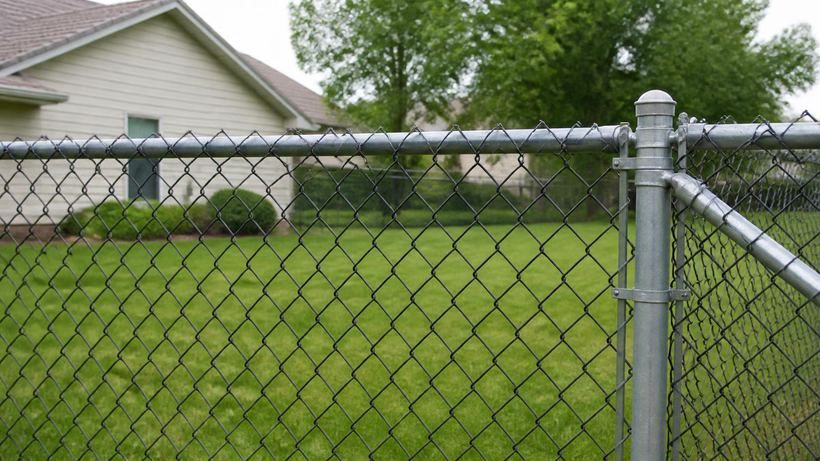
Wire gauge, and why a lower number is the better wire
Gauge is the thickness of the steel wire woven into the diamonds, and the scale runs backward: the smaller the number, the heavier the wire. Eleven-and-a-half gauge is the thin fabric in pre-rolled home center kits. Eleven gauge is a step up and shows up on plenty of residential quotes. Nine gauge is what a supplier means by residential-commercial fabric, and it is the grade worth paying for behind a house with a dog in it.
Think of it as recovery. Lean on light fabric and the diamonds stretch and stay stretched; heavier wire takes the same shove and springs back. A big dog hitting the fence at a run tests exactly that. Gauge belongs on the proposal as a number, because the word residential covers three very different fences.
Mesh size: how big the diamonds are, and what that costs
Mesh is measured across the opening of one diamond. Two inch is the residential standard, and unless the quote says otherwise, that is what arrives. Tighter weaves -- one and three quarter inch, one and a quarter inch, the fine mini-mesh on tennis courts -- cost more per foot because there is more steel in the same square of fabric.
Tighter mesh buys stiffness, climb resistance because a shoe toe cannot seat in the opening, and a more solid look from an angle. Wider mesh does the reverse: more open, easier to see through along a rear line, but it hands a climber a foothold and lets a small terrier work a gap.
Galvanized, black and green: the finish you notice, or do not
Galvanized fabric is zinc-coated steel wire: bright silver for a season or two, then soft matte gray as the zinc weathers. It is the cheapest and most visible fabric, and nothing is wrong with it on a back line or a utility area.
Vinyl-coated fabric is that same wire with a polymer jacket fused over it, usually black. The reason black wins is optical, not fashionable. Silver wire catches light and pulls your eye to the grid, so you see fence. Black reads as shadow, so against a tree line, a hedge row or a wooded rear lot it visually dissolves and you look through it at the yard. Green does the same against summer foliage, then stands out once the leaves drop.
Coating quality varies more than the color chart suggests. A thin jacket splits at the knuckles where the wire turns, and once it opens, moisture sits between polymer and steel and corrosion starts where nobody can see it. Ask how thick the coating is and what the core gauge is underneath, since some suppliers quote the finished diameter including the jacket. If the front yard is the real concern, powder-coated aluminum fence panels answer it differently.
The framework: terminal, corner, end and line posts
A chain link fence holds its shape because of the pipe, not the wire. Fabric is only as straight as the framework it gets pulled against, so the post schedule deserves a second read.
- Terminal posts are the ends, corners and gate posts. All the tension in a run dead-ends at one, so they run a larger diameter and heavier wall than anything between them.
- Corner posts are terminal posts with fabric pulling two directions at once. They carry two runs worth of load at an angle and deserve the deepest footing on the job.
- End posts stop a run at a garage wall or an existing fence, and get the same heavy treatment as a corner even though one side pulls.
- Line posts sit between terminals, normally no more than ten feet apart, and their job is carrying fabric and holding the line rather than resisting tension.
- Loop caps ride on line posts to carry a top rail; terminal posts take a solid dome cap and a stack of tension bands instead.
Top rail or top tension wire
A top rail is a continuous pipe threaded through the loop caps on every line post and swedged together end to end. It ties the fence into one assembly, holds the top edge dead straight and stiffens the fabric against anything leaning into it.
A top tension wire is one heavy wire run along the top and tied to the fabric instead. It is cheaper, faster, and normal on tall commercial fence. It also flexes, and records every event it survives -- a dog pushing, a branch coming down. The top line goes wavy and stays wavy, because nothing rigid is up there to pull it back.
Tension bands, tension bars and bracing at the corners
These small parts are where tension is held or quietly lost. A tension bar is a flat steel bar woven vertically through the last column of diamonds at a terminal post, turning a floppy fabric edge into a rigid one that can be pulled. Tension bands are the loops that wrap the post and bolt through that bar, spreading the load down its length -- roughly one band per foot of fence height.
On anything five feet or taller, corners and gate posts should also get a brace assembly: a horizontal pipe from the terminal post back to the first line post, plus a diagonal truss rod with a turnbuckle pulling the other way. The pipe pushes, the rod pulls, and the triangle stops years of fabric tension from tipping the post inward. Braces are invisible on install day and obvious three winters later.
Fabric heights and what each one is honestly good for
Height gets picked from a catalog far too often. Pick it from the job the fence has to do:
- Three feet: a garden edge, a front boundary, a border around a play area. It marks a line and stops very little.
- Four feet: the most common residential height in central Ohio, containing most dogs and small children without swallowing the view.
- Five feet: where people land after a four-foot fence has already been cleared, or where a slope drops the effective height downhill.
- Six feet: full containment for an athletic dog, the height that accepts slats without looking odd, and the usual back-yard ceiling.
- Taller than six feet: normal around a sport court, unusual behind a house, and a zoning conversation first.
Stretching and tension: what a loose fence looks like a year later
Chain link is the one fence where the fabric is a structural element rather than a skin hung on a frame. It is meant to sit under load permanently, and getting it there is deliberate:
- The fabric is hung along the run and a tension bar bolted into the first terminal post, so the starting edge is rigid rather than loose.
- A stretcher bar and a come-along pull the roll toward the far post until the diamonds change from leaning parallelograms into even openings you cannot twist by thumb.
- Only with the fabric held tight is the far end trimmed, barred and bolted to the terminal bands, so no pull is lost while the end is fitted.
- Ties go on last, along every line post and the top rail or tension wire, spreading the load rather than creating it.
Privacy slats, screen fabric and the wind load you just added
Slats are flat or tubular strips pushed down through the diamonds. Bottom-lock and top-lock slats clip so they cannot walk out; wing and tube profiles fill more of the opening. Expect roughly three quarters to nine tenths coverage -- enough to break up sight lines, not enough to make a yard private. If actual privacy is the point, a wood privacy fence or a solid vinyl fence is the honest answer.
The rest is structural. Open chain link is nearly transparent to wind, which is why it gets away with slimmer posts and footings. Fill the diamonds and you have built a sail. Say slats out loud before the framework is priced: that means heavier terminal posts, closer line spacing and braced corners. Slatting a fence already standing is how a straight fence starts leaning.
Dogs: diggers, climbers, and the fixes that actually hold
Diggers go under the bottom edge, which on a careless fence is fastened to nothing at all. A bottom tension wire woven through the last row of diamonds and tightened between terminal posts pulls that edge into a line the dog cannot lift. For a committed digger the stronger answer is a buried edge: galvanized wire cloth bent into an L, buried shallow and turned outward into the yard, so paws hit wire instead of dirt.
Climbers need height and a top with nothing to grab. Mesh matters more than height there, because a two-inch diamond takes a toe and a one-and-a-quarter-inch diamond does not. A roller bar spinning above the top rail defeats the ones that go over anything static. Check the gate separately, because the gap between a gate frame and its post is the escape route nobody inspects. Dogs come up constantly on the Pickerington page.
Gates: walk gates, double drive gates and cantilever slides
A walk gate is a frame of the same pipe filled with the same fabric, hung on two hinges and closed with a fork latch, usually three or four feet wide. Everything that goes wrong with gates traces back to the post. A gate leaf is a lever, the hinge side eats that leverage on every swing, and a line post used as a gate post is the surest route to a dragging gate by spring.
A double drive gate is two leaves meeting in the middle, which is how a mower, a trailer or a truckload of mulch gets into a back yard. It wants a drop rod into a ground sleeve to hold the inactive leaf, and a reasonably level opening. A cantilever slide gate is the alternative where nothing has room to swing: it rolls sideways on trucks mounted to the posts, carried in balance rather than hung, and it needs a runway behind the opening of about half again the gate width. Narrow side yards settle much of this, as on the Upper Arlington page.
Footage, height, gauge, gate count and grade move a chain link number far more than color does. The layout and setting work behind all of it lives on the fence installation page, and a stretched, sagging or torn fence belongs on the fence repair page instead. Send the address and a few photos of the property line to get a scope and a number.
Chain link fence Columbus Ohio — common questions
How much does a chain link fence cost in Columbus?
Nobody can answer that from a keyboard, but you can learn what moves it. Footage sets the baseline. Height, wire gauge and mesh size stack on top, and coated fabric costs more than galvanized. Gates are the multiplier, since each means heavier posts, a frame and hardware. Rock, tree roots in the post line and old-fence removal add labor. The contractor prices it after seeing the yard.
Is black vinyl-coated chain link worth it over galvanized?
For a fence you look at daily, usually yes. The difference is a percentage of the job rather than a doubling, and you get a fence that recedes instead of announcing itself, especially with trees behind it. The jacket is a second barrier over the zinc too. The caveat is quality: a thin coating splits at the knuckles and traps water against the steel, so cheap coated fabric ends up worse than good galvanized.
What gauge and mesh should I use for a large dog?
Nine-gauge fabric in two-inch mesh handles almost any dog that pushes, leans or hits the fence at speed, and it is the upgrade most worth the money here. Drop to one-and-three-quarter-inch or one-and-a-quarter-inch mesh if the dog climbs, since a smaller opening will not take a toe. Add a bottom tension wire either way. Four feet holds most dogs; a jumper wants six with a rail on top.
How long does a chain link fence last?
The fabric usually outlives everything attached to it. Galvanized wire in a residential yard commonly goes twenty to forty years, and coated fabric can run longer while the jacket stays whole. What fails first is rarely the wire. Ties break one at a time, bands loosen, unbraced corners tip, and shallow-set posts move with freezing and thawing. Rebuilding the framework and reusing sound fabric is common.
Can privacy slats be added to a chain link fence already up?
Physically yes, and slats are sold for exactly that retrofit. Structurally it deserves a look first. The fence was built as an open screen wind passes through, and slats turn it into a panel that catches every gust. Before filling the diamonds, check that the posts are real fence-grade pipe, that the corners are braced, and that nothing leans yet. Tighten slack fabric first, because slats on loose wire look worse.
Can you paint an existing galvanized chain link fence black?
It can be done, with mixed results. Zinc is a poor surface for paint, so it takes real cleaning, a self-etching primer meant for galvanized metal, and a sprayer rather than a brush, and thousands of small wire crossings are tedious. Expect wear at the knuckles and wherever fabric rubs a post. Factory-applied coating on new fabric is fused to the wire in a way field paint never will be.
Talk through your site
Start with the address, what you want done, and a few photographs of the area, including anywhere water sits after a heavy rain.
Related work
Fence Installation
New residential fences, laid out, set and finished for central Ohio frost and glacial till.
Fence Repair
Leaning posts, dragging gates, wind damage and rotted boards, and when a repair stops making sense.
Wood Privacy Fences
Board-on-board, shadowbox and stockade privacy fences, and what makes wood last here.
Vinyl Fences
Low-maintenance vinyl privacy and picket fences and how they behave in an Ohio winter.
Aluminum & Ornamental Fences
Ornamental aluminum for front yards, graded lots and pool enclosures.
Across the metro
Upper Arlington
Established streets, mature trees and tight side yards where access decides the method.
Worthington
An older village core plus newer subdivisions, with big trees and creek-side grade changes.
New Albany
Planned neighborhoods where architectural review has a say before anything is ordered.
Pickerington
Newer Fairfield County subdivisions, flat lots, dogs and covenants on height and style.