Home › Services
Vinyl fence Columbus Ohio: how to tell a good panel from a cheap one
Vinyl fence is rigid PVC, not plastic sheeting, and the gap between a good panel and a bad one is wider in this material than in anything else you can put along a property line. Two fences can look identical the week they go up and be a decade apart in how they age. What separates them is the compound that ran through the extruder, the wall thickness you cannot see from the sidewalk, and whether anyone thought about what a January cold snap does to a hollow section. This page is about reading those differences before you commit.
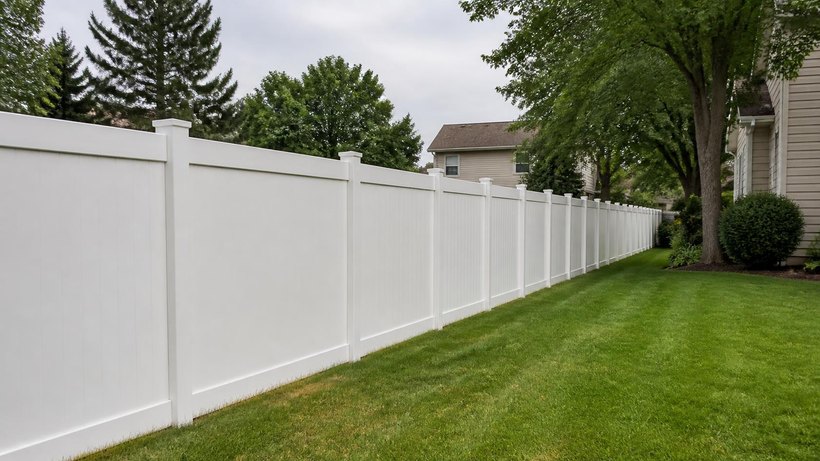
What vinyl fence actually is
The material is rigid polyvinyl chloride, extruded into hollow profiles: square posts, hollow rails, flat or tongue-and-groove pickets. Nothing about it is structural the way a wood post is. A vinyl fence gets its stiffness from geometry and from how the parts lock together, so the engineering hides where a homeowner never looks.
The compound decides quality. A good extrusion runs virgin PVC resin with a measured dose of titanium dioxide for ultraviolet protection and impact modifier to keep the material from going glassy in the cold. A cheap one leans on reground scrap, cuts the titanium dioxide because it is the expensive ingredient, and skips the modifier. Better lines are co-extruded: a richer outer skin carries most of the ultraviolet package while the inner body carries the bulk.
Wall thickness, and the visible tells of a cheap panel
Post wall, rail wall and picket wall are three separate figures, and a supplier who publishes all three is telling you something. The cheapest fences on the market are built by thinning the wall a few thousandths at a time until the panel barely holds its shape, because thinning is invisible in a photograph and shows up directly in the price. Handle a physical sample of the exact product quoted, not a brochure.
- Flex. Push a picket at the middle. A good one springs back flat; a thin one keeps a memory of the bend.
- Translucency. Hold the sample to the sun. Light glowing through means very little wall, and little pigment behind the color.
- Chalking. Rub the face hard with a dark cloth. White powdery residue on a weathered sample is resin breaking down.
- Yellowing. Compare an exposed piece to a fresh one. A shift toward cream in two seasons is formulation, not dirt.
- Fit. Pickets should slide into a routed rail snugly, with no slop and no forcing.
- Caps. Post caps that need hammering, or drop off in your hand, tell you the tolerances are wide.
Cold-weather brittleness, and the impact question that matters here
This is the central Ohio issue, and it is worth being blunt. Rigid PVC gets harder and less forgiving as temperature drops. Below freezing, a panel that would have shrugged off a knock in July cracks instead, and the crack runs the length of a picket rather than stopping where it started. Impact modifier is the ingredient that buys the cold-weather toughness back, and suppliers who care about it raise low-temperature impact resistance unprompted.
The hazards are ordinary. Snow thrown off a blower against a bottom rail in February. A basketball off the rim. A string trimmer whipping the same rail until it looks sandblasted. A real compound absorbs all of that; a thin one spiders.
Ultraviolet stabilizers, and why white ages differently from tan and gray
Titanium dioxide does two jobs at once. It makes vinyl white, and it blocks ultraviolet light from reaching the resin underneath. That coincidence is why white is the benchmark: the color demands a heavy dose of the pigment, so the ultraviolet protection comes along for the ride.
Tan, clay and gray are a different problem. Color comes from other pigments and the titanium dioxide drops. Good manufacturers compensate by putting the color into a co-extruded outer layer with its own stabilizer package, so the skin doing the weathering is built for it; weaker ones tint a thin body. Expect a colored fence to shift more over its life than a white one, expect the south and west runs to shift first, and expect any fade to be even rather than blotchy instead of streaked.
Routed-rail panel systems versus a board-and-batten look
Almost all residential vinyl privacy fencing is a routed-rail system. Rails arrive slotted along their length, tongue-and-groove pickets slide in and interlock edge to edge, and the section drops into routed holes in the posts. Nothing is fastened through the face: no screw heads to stain, no nails to work loose, every piece free to move.
The board-and-batten look is built differently, with flat boards side by side and a narrow vertical strip covering each joint. More parts, more cost, but the shadow line gives a long run a heavier face that reads much less like plastic. Between the two sits the real decision: how solid the face is.
Internal aluminum reinforcement, and where it is not optional
Hollow vinyl sags under its own weight over a long enough span, and it will not hold a hinge under load. The fix is aluminum channel or a steel insert running inside the profile, hidden completely. The question is whether the quote includes it where it belongs.
Gates are where it is genuinely non-negotiable. An unreinforced vinyl gate frame racks out of square, and once it is out of square it drags and it quits latching. Every leaf needs reinforcement in the frame; a wide or double drive gate needs it in every member plus hardware sized for the real weight. The other place to insist is the bottom rail of a tall privacy panel on a long bay, which carries every picket above it and develops a visible smile in the middle within a few summers.
Expansion and contraction: a vinyl fence must not be built tight
PVC moves with temperature far more than wood or steel does, and central Ohio hands it a wide annual swing. A rail that fits perfectly on a ninety-degree August afternoon is measurably shorter on a ten-degree January morning. Build with no allowance for that and the fence either buckles in the heat or pulls its rail ends out of the post routs in the cold.
Everything about a good vinyl fence is designed to float. Pickets sit loose in their slots rather than glued. Rail ends sit inside the post routing with room to grow and shrink. Fasteners keep parts from sliding out; they do not clamp. So a little play in a new fence is correct, not sloppy. Hole depth, concrete, grade and gate framing belong on the fence installation page rather than here.
Cleaning: the short maintenance list vinyl actually has
Nothing gets stained, sealed or refinished. What vinyl collects is a film of pollen, road grit, mildew and algae that turns white a dull gray-green, worst on shaded runs and the lowest twelve inches. People read that film as fading, and it is not. Once a year, after the spring pollen drops, walk the fence and do this.
- Rinse the whole run with a garden hose first, so a brush does not drag loose grit across the surface.
- Wash with warm water and mild dish detergent on a soft bristle brush, working from the bottom up.
- For the green cast on shaded panels, use a dilute exterior cleaner, let it sit briefly, then rinse well.
- Skip abrasive pads, scouring powder and solvents. They scratch the skin, and a scratched surface holds dirt from then on.
- Keep any pressure washer gentle and the tip well back, and never aim it into rail slots.
- Cut grass and mulch back off the bottom rail, and check each post base for movement.
Repairability and the profile-matching problem
A cracked picket in a routed-rail system is easy in principle: unpin the section, slide the damaged picket out, slide a new one in. The difficulty is not labor, it is finding a picket that matches, which is the argument for a mainstream product carried by suppliers in central Ohio.
Vinyl profiles are not standardized. Rail dimensions, picket width, tongue-and-groove geometry, post routing and the exact shade of white all vary by manufacturer, and lines get discontinued. Match a five-year-old fence from an unknown import and nothing on the shelf may fit, at which point one broken picket becomes a whole section in a slightly different white. Have the manufacturer and product line written on the paperwork, and keep a spare picket in the garage. Post heave, leaning sections and dragging gates are covered on the fence repair page.
Styles, and when vinyl is the wrong answer
The style list is shorter than wood but covers most of what a central Ohio yard needs, and the choice moves wind load and cost as much as appearance.
- Full privacy. Tongue-and-groove pickets the full height, solid face. Maximum screening, maximum wind load, and the style needing reinforced bottom rails.
- Semi-privacy. Pickets spaced slightly apart, or solid below with spaced accent pickets above. Screens the sightline and still passes air and light.
- Lattice top. A solid panel finished with a band of lattice under the top rail, the usual way to soften a tall run.
- Picket. Three or four feet, spaced pickets, gothic or colonial tops. A front-yard fence that holds a small dog.
- Post and rail. Two or three horizontal rails and no privacy at all, used to define a line across a flat lot.
Choosing vinyl against the other materials
Vinyl earns its keep when you want privacy and you do not want a maintenance cycle. It never needs stain, it will not rot at the ground line, and a clean white fence in year ten looks close to year one if the compound was right. It costs more up front than the alternative that screens the same amount, it cannot be repainted later, and it is the material least tolerant of a cheap product.
If budget is the constraint and you accept refinishing on a cycle, compare it with a wood privacy fence. If the job is containing a dog along a back line, chain link does it for less. For a front yard, a slope, or a pool enclosure where gate hardware rules drive the design, ornamental aluminum usually fits better. Covenants in the newer subdivisions often dictate color and height before you get a vote, which is why the Pickerington page spends its time on association submissions.
Footage, height, the number and width of gates, how much reinforcement the design needs and how much the ground moves will shift the number more than the brand on the panel does. The contractor prices it after walking the line. Send the address and a few photos from the contact page.
Vinyl fence Columbus Ohio — common questions
Does vinyl fencing crack in cold weather?
It can, and the grade of the product decides how likely that is. Rigid PVC stiffens as the temperature drops, so a panel takes an impact less forgivingly in February than in July. Compounds built with a proper impact modifier hold their toughness deep into an Ohio winter. Thin panels made without the modifier spider when a snow blower throws ice at a bottom rail. Ask about low-temperature impact performance before comparing prices.
How long does a vinyl fence last in Ohio?
A well-formulated vinyl fence on properly sized posts should still be doing its job decades out, longer than a wood fence of the same height holds up here without steady refinishing. The qualifier matters. Longevity in vinyl is bought with titanium dioxide, impact modifier and wall thickness, none of which show in a photograph. Thin panels from an unknown compound can chalk, yellow and crack within a handful of winters.
Why does my white vinyl fence look gray or dingy?
Almost always surface film rather than the material failing. Pollen, road grit, mildew and algae build into a thin gray-green layer, heaviest on shaded runs and along the bottom foot, and it comes off with warm water, mild dish detergent and a soft brush. If a scrub test on one section brings the white back, the fence needs nothing but a yearly wash. A cloth loaded with white powder instead means chalking.
Can a broken vinyl fence picket be replaced?
Yes, and the labor is straightforward on a routed-rail system: the section comes apart, the damaged picket slides out, a new one slides in. The hard part is sourcing a picket that matches. Vinyl profiles are not interchangeable between manufacturers and product lines get discontinued, so a fence built from an unknown import can be unmatchable later. Buy a widely distributed product and keep a spare picket.
Do vinyl fence gates need metal reinforcement inside them?
Treat it as mandatory. Hollow vinyl will not carry a hinge load, so an unreinforced gate frame racks out of square, then drags and quits latching, and no amount of hinge adjustment fixes it afterward. Every gate leaf should have aluminum or steel channel inside the frame, a double drive gate should have it in every member, and the hardware should be sized for the weight of the leaf.
Is vinyl fencing more expensive than wood?
Up front, generally yes for the same height and the same amount of screening, and the gap widens with a color or a board-and-batten face. Over the life of the fence the comparison shifts, because vinyl needs washing while wood needs cleaning and refinishing on a cycle plus eventual board replacement. What moves the number most is not the material anyway: footage, height, gates, grade and reinforcement.
What color vinyl fence holds up best over time?
White, for a reason that is more chemistry than taste. The titanium dioxide that makes vinyl white is also what blocks ultraviolet light from reaching the resin, so a white panel carries a heavy protective dose as a side effect of its color. Tan, clay and gray use other pigments and less of it, which is why colored fences drift more, and why the south and west runs drift first.
Talk through your site
Start with the address, what you want done, and a few photographs of the area, including anywhere water sits after a heavy rain.
Related work
Fence Installation
New residential fences, laid out, set and finished for central Ohio frost and glacial till.
Fence Repair
Leaning posts, dragging gates, wind damage and rotted boards, and when a repair stops making sense.
Wood Privacy Fences
Board-on-board, shadowbox and stockade privacy fences, and what makes wood last here.
Chain Link Fences
Galvanized and black-coated chain link for yards, dogs and back property lines.
Aluminum & Ornamental Fences
Ornamental aluminum for front yards, graded lots and pool enclosures.
Across the metro
Upper Arlington
Established streets, mature trees and tight side yards where access decides the method.
Worthington
An older village core plus newer subdivisions, with big trees and creek-side grade changes.
New Albany
Planned neighborhoods where architectural review has a say before anything is ordered.
Pickerington
Newer Fairfield County subdivisions, flat lots, dogs and covenants on height and style.